
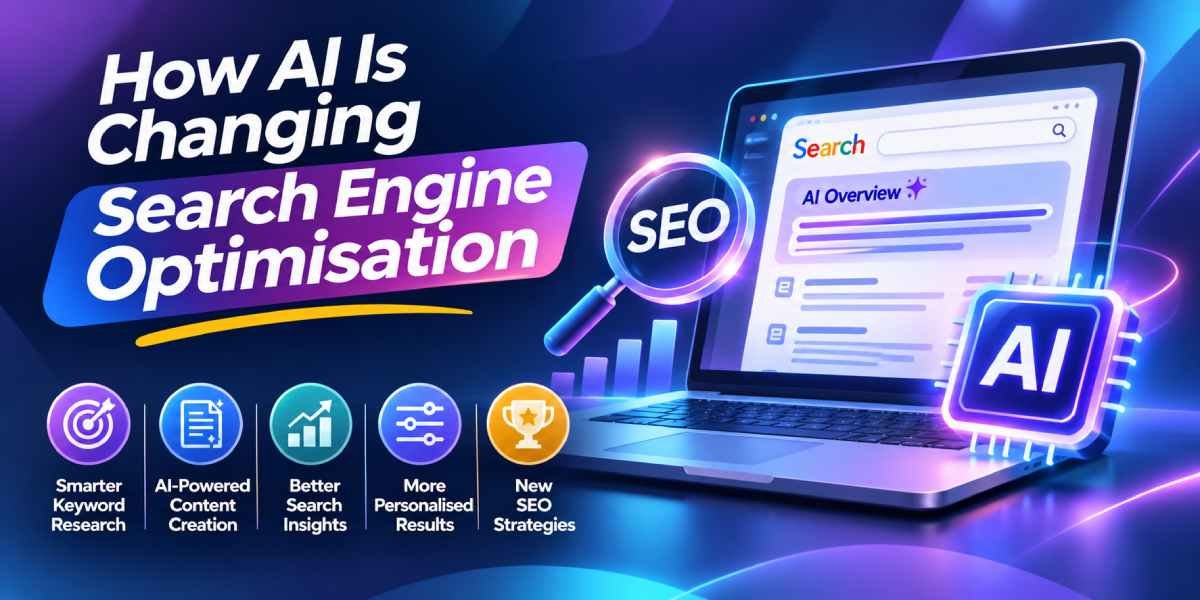
How AI Is Changing Search Engine Optimisation
While AI has not removed SEO as a practice, it has certainly made it more challenging. Search engines are moving away from blue-listed links and towards more conversational and synthesised results. If you adapt your content, technical foundations and brand, then your business will continue to be visible. We can help you understand how to adapt your SEO practices using practical techniques.
SEO has traditionally been quite straightforward. You would conduct keyword research, optimise your content and then build links. However, AI has changed the game. Google have stated that search features powered by Generative AI are based on its core ranking and quality systems. This means that your technical structure and quality content remain key.
The new technology in the search engine and artificial intelligence will have the capability to determine the user’s needs, what they are searching for, and how they will know whether it is trustworthy. Therefore, the businesses that put their efforts into this will be rewarded.
Keywords to Intent
SEO was traditionally all about keyword research and integrating these keywords into your titles, headers, and content. Although these are crucial, today’s search engines are now built to comprehend the meaning of the search.
A search for ‘best CRM for small business’ can be seen as wanting to compare different options; however, someone searching for ‘why is my CRM not syncing’ may be looking for help. AI can detect the intent of the search and provide different content, summaries and questions.
Content creation will need to look at the whole theme rather than just individual keywords. A good page will provide the main answer to the question, address any concerns, give context and show you have real understanding. We use these principles when providing SEO for our clients.
Intent is now one of the main focuses of modern SEO.
AI Answers & Zero-Click Searches
AI can provide summaries (such as Google’s AI Overviews) that can answer many questions. This can be a huge issue for publishers.
However, this doesn’t mean that SEO is dead. The role of your website will now change, as you will need to compete for mentions, citations and visibility within AI-powered answers. Research shows that AI Overviews can impact organic clicks. However, users will still use traditional search results for more detailed research, conversions and brand evaluation.
Your content will need to be unique, as you can no longer provide generic content. It needs to provide a unique angle, insight and proof of expertise.
We can help you understand which pages are most at risk of zero clicks and what topics will give you real visibility. We want to ensure that we are attracting quality visitors.
Quality Content
AI has increased the level of quality needed within your content. Search engines are now better at recognising low-quality content such as thin content, duplicated ideas and content that is only there to try and rank. On the flip side, they are now better at understanding quality content, with clear structure and real insights.
Good content will usually provide a quick answer, simple explanation, facts to back up your claims and reasons why you can be trusted. It should also show that you have real experience.
Google have highlighted that unique and valuable content, with clear technical structure, will still be key to visibility in generative AI search. This shows that AI optimisation isn’t replacing SEO; it is extending it.
At Techjeta, we always start with your audience. Before creating any content, we will look at the questions your customers are asking, what gaps we see in your competitors, what the commercial intent is and what real expertise you can show. This helps avoid the common pitfall of creating content for the search engines.
E-E-A-T Has Never Been More Important
Experience, Expertise, Authoritativeness and Trust (E-E-A-T) has become key in SEO. AI needs to know which sources to quote, summarise and recommend. This is largely down to trust.
A blog post written by an unknown author with no evidence will not be as appealing as one written by a known expert who will explain how something works, provide real insights and back up their conclusion. The same applies to service pages, product guides, case studies and thought leadership.
You can increase your trust by showing who has written the content, showing their credentials, citing reliable sources, providing original research and ensuring your information is accurate and up to date. Avoid showing AI-generated drafts as expert content without human review. Google’s updated guidelines highlight that we should be fact-checking and reviewing AI-assisted content.
At Techjeta, we place great importance on building a credible online presence. We will ensure your messages are clear, content is detailed, your brand is consistent, and your expertise is shown across your key pages.
Technical SEO Still Matters
No matter how good the content you use, if search engines fail to crawl, render, and index it, it won’t help. Indeed, the need for Technical SEO has become even greater with the emergence of AI technology. Your website should have a good structure, fast speed, be mobile-friendly, secure connections, and proper internal linking and indexing.
In fact, Google recommends making sure that your content is crawlable and has good technical structure in order to improve your visibility in the world of AI-powered search. In order to do this, you should use structured data.
By having a good technical website, you are setting up your other SEO efforts. Your quality content will be accessible, your key pages will be prioritised, and search engines will understand the context of your offering.
We will ensure your technical SEO is improved to help drive long-term growth. We will fix crawlability issues, improve structure, improve internal linking, improve page performance and ensure key content is easy to understand.
Answer Engine Optimisation
A new area of SEO, known as Answer Engine Optimisation (AEO). This focuses on ensuring your content is easy for AI to understand, pull out and reference. This does not replace SEO but builds on it. You want to provide clear answers but also enough detail to entice people to visit your page.
Effective AI-ready content will usually be quick to read, well organised and specific. It will have clear headings, concise information, relevant examples and well-separated content. Questions will be answered to help with any follow-up questions.
The best way to do this is to firstly create content for humans. Keep paragraphs short, with a clear heading structure, factual and well-defined. Industry guidance highlights that using semantic HTML, logical structure, and accessible media such as image alt text and video transcripts will help.
We can help you create content that is easy to read and reference.
Brand Authority
In an AI-powered search landscape, brand recognition has never been more important. If your brand keeps coming up with helpful content, trustworthy mentions, reviews and consistent messaging, users will be more likely to search for you directly, trust your recommendations and choose you over unknown brands.
AI often uses a wide range of factors to understand your brand. This includes content on your website, mentions, reviews, expert opinions and consistent information. This makes Digital PR, reputation management and thought leadership increasingly important.
If you provide insightful analysis of your industry, engage in relevant conversations and keep your information accurate, you are much more likely to be recognised as a trustworthy source. This can influence your traditional rankings and AI answers.
We can help you build your authority. We will ensure your brand is consistent, provide content with expertise and ensure your brand is correctly represented.
SEO KPIs Are Changing
While rankings and organic traffic are still useful KPIs, they aren’t telling you the full story. You may be getting fewer clicks from AI Overview but are increasing brand awareness, assisted conversions or direct searches. Alternatively, you may get a small amount of traffic, but it will be high quality.
Modern SEO should focus on quality engagement, increased branded searches, conversions, quality leads and visibility in AI-powered search. You should ask yourself: have the right people found you, understood your value and taken action?
This means looking at your SEO from a more strategic viewpoint. We can help you understand how your SEO is impacting your business.
What Should You Do?
Not necessarily the businesses with the most content will succeed in AI-powered search. Those who have a solid foundation, real expertise, and understand their audience will.
Audit your key pages. Are you answering the questions your customers are asking? Are you showing real experience and trust? Can search engines easily crawl and understand your content? Is your content unique enough to stand out in a world where AI can summarise general knowledge?
Invest in depth. Create service pages that explain what you offer, why and how. Provide guides showing real knowledge from operations. Keep your content simple, back up your claims with facts and ensure it is kept up to date with changes in your industry.
Finally, SEO should be an ongoing process. Search behaviour, AI features and rankings are constantly changing. Those who consistently improve their strategy will be best placed.
Conclusion
AI will change the way we do SEO permanently. There is a shift from keywords to intent, trust and quality responses. Search is becoming more conversational, selective and based on trust. Yet, the secret remains the same. The ones offering true value will be more discoverable, trusted and scalable.
Organisations that comprehend SEO as an asset will win the game. Through a combination of technical skills, high-quality content and your brand image, AI can be treated as an advantage. Our team can help you embrace the change with our professional SEO services for improved visibility, authority and conversion of search demand into results.