
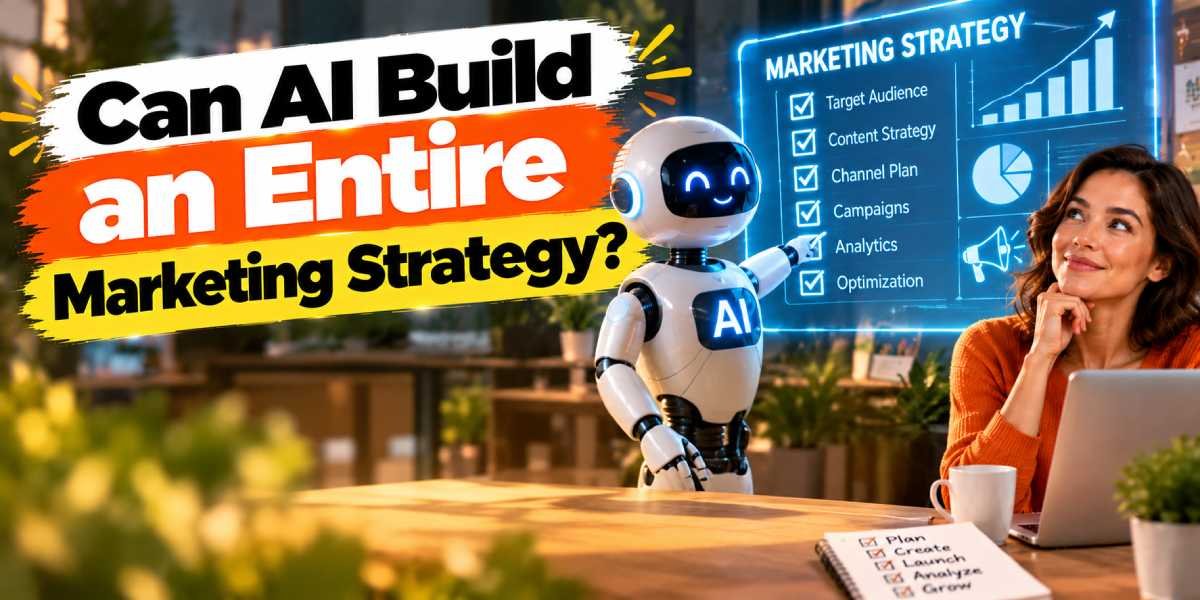
Can AI Build an Entire Marketing Strategy?
AI can help in studying markets, analysing customer data, creating campaigns, developing personalised messages, and optimising the performance of the campaigns through various channels. But does it have the capability of developing an entire marketing strategy? In practical terms, no—if you want your strategy to be viable, safe, and aimed at sustainable growth.
AI excels at speeding up all the processes related to the development of strategy. It’s very good at analysing large amounts of data, trying out new concepts, developing variations on a theme, and discovering opportunities more quickly than a human team could do so manually. However, AI still falls short of making those decisions that only humans can make: choosing the right market, addressing the right problem of the customers, defining the brand voice, and making choices that will help preserve the brand’s value in the long run.
This is important to realise for tech-savvy organisations. AI won’t be a plug-and-play marketer for you. It’s a highly efficient part of a carefully designed marketing process that requires clean data, clear goals, creativity, and proper management.
What AI Can Genuinely Do
AI technology is no longer limited to generating content. Nowadays, marketing departments are utilising the technology to recognise behavioural indicators, determine key target groups, make predictions about customer engagement, and conduct marketing campaigns through real-time measurements. The technology may also personalise in real time using email, paid ads, web pages, and social media based on user intent.
AI can support several key areas of marketing. By analysing large volumes of customer and market data, it can uncover insights that might otherwise go unnoticed. It can also segment audiences based on behaviour rather than demographics. Additionally, AI can generate initial drafts of advertisements, website content, and SEO materials. It can also propose changes in budget allocations, tests of various creatives, and underperforming campaigns.
All this explains why AI is such a powerful marketing tool now. With the help of AI, marketing departments can reduce days spent on analysis of data in spreadsheets and production of multiple messages to minutes. All this results in a greater amount of time spent on value-adding activities such as positioning, creative ideas, understanding of customers, and business decisions.
Where AI Falls Short
The limitation is not that AI lacks capability. It is that strategy requires judgment that cannot be fully reduced to a prompt.
Even though AI may be tailored to achieve specific goals, it does not mean that it understands whether these are actually the right goals for the organisation. It can generate content; however, it will not necessarily understand the nuances of brand positioning, cultural nuances, the competitive environment of the brand, or the reasoning behind choosing one solution over the other on an emotional level. In addition, AI can perform analysis of the historical data; however, it cannot comprehend something that never happened before.
There can be operational risk due to the possibility of the AI generating wrong statements, having bias due to the data used to train it, or making personalised decisions which might appear too intrusive to the consumer. Privacy concerns arise due to the involvement of the consumer’s data in AI marketing campaigns.
A strategy built entirely by AI may look impressive on the surface: audience segments defined, keywords selected, content calendars populated, and campaign budgets allocated. But without human validation, it can become a collection of technically plausible recommendations that fail to support the company’s actual growth model.
Strategy Is More Than Automation
Marketing strategy answers questions that automation alone cannot resolve.
What is the target customer, and what problem are they solving? What makes the brand believable in such a cluttered space? Where should marketing investment go first? How does the organisation navigate between lead gen and brand equity? What is the right message for the technical buyer versus the decision-maker?
All of these decisions are decisions that may very well be impacted by AI. AI can find out the intention, understand competitive messaging, identify areas lacking in content, and model future consumer behaviour. However, when it comes down to what should be done about this intelligence, that’s a marketer’s call.
Think of AI as an advanced analytical engine, not a chief marketing officer. It can tell you what is happening and suggest what might work next. A skilled strategist decides what should happen—and why.
The Right Way to Use AI
The most effective approach is not “AI versus marketers.” It is AI-enabled marketing led by experienced professionals.
A good AI-based strategy must begin with a clear understanding of the business’s objectives, target audience, value proposition, and success factors. Once all these are established, the technology could help in finding out the demand, analysing customer data, spotting opportunities, and measuring the performance of messages on a large scale. But all these insights need to be analysed and interpreted by humans who will fine-tune positioning and ensure that the campaign is aligned with brand and business objectives.
This method ensures the reduction of any risks without slowing down the process. While the AI solution will be able to give recommendations immediately, it will be marketers who have to choose those recommendations that should be further developed. An AI solution will be able to assess the patterns of performance, while only human experts can understand how to apply this information to ensure success. An AI solution will be able to recommend large-scale personalisation, while only human experts can implement it correctly.
It seems that the organisations that would benefit from AI integration are not necessarily those who use more AI tools.
Where Techjeta Fits In
This is where Techjeta adds value. Rather than selling another tool or asking businesses to navigate AI complexity alone, Techjeta provides professional marketing services that turn AI-enabled insight into a practical, revenue-focused strategy.
Techjeta’s team helps businesses define the strategic foundation AI needs to perform well: audience understanding, positioning, messaging, channel priorities, content direction, and performance measurement. From there, Techjeta applies AI-supported research, analytics, content development, and optimisation techniques where they create real value—without allowing automation to replace strategic thinking.
These are the requirements of companies that require a full-service solution, which would comprise digital marketing strategy creation, SEO, content marketing, paid advertising, social media marketing, brand communication, analytics and optimisation. It is not just about creating additional marketing material. Rather, it is about developing a system in which research, creativity, dissemination and analysis converge toward one goal of growth.
Techjeta also recognises that every business faces unique challenges. A young startup might be required to establish itself quickly in terms of demand generation and building credibility. A growing tech company may need higher-quality leads that align more closely with their sales process. A trusted brand may require an upgrade to its online presence without losing its strengths. In both cases, the appropriate course of action would be determined by the specific circumstances.
A Practical AI Marketing Framework
A realistic AI-enabled marketing strategy usually follows a simple sequence.
First, one has to define the objective of their business – pipeline, brand building, customer retention, product adoption or market expansion. It is impossible to ask AI to come up with any strategy unless the objectives are defined.
Develop an intelligence layer using Techjeta to collect all the inputs that are required by AI to operate: customer intelligence, search and market research, competitors, website and campaign intelligence, audience intelligence. Without good-quality inputs, it is impossible for AI to offer any useful recommendations, regardless of its technological sophistication.
Identify the strategic direction for your business based on positioning, target audience, messaging pillars, channel strategy, topics to cover, and the conversion process. Strategic decisions require intelligence because they impact the reputation of your business in the business environment.
Launch campaigns using the power of AI execution: research, various versions of the copy, creative testing, segmentation, personalisation, performance evaluation. Our marketing experts make sure that all these deliverables are consistent with each other and aligned with the branding and goals of the campaign.
The last stage is the evaluation of the results and taking lessons from them. The AI will help you spot the trends in time, but only a human being will understand what action you need to undertake as per these trends, whether to continue with your message or change it.
Why Human Expertise Still Wins
Marketing has become much quicker, data-driven, and more experimental because of AI tools. This is one of its key strengths. However, quickness without the compass leads to noise, and data without interpretation leads to misguiding confidence.
Those corporations that have found great success through AI have managed to remove all routine tasks and improve their capacity for experimentation. Such corporations employ competent marketers who ask the right questions, challenge assumptions, discover what their consumers really want, and take decisions that contribute to their future success. It is a proven fact that AI creates value in synergy with human control, expertise, and responsibility.
It is particularly true about marketing technologies, where the purchasing processes may be rather complicated and the range of stakeholders quite varied. The successful strategy has to connect technical benefits with the business ones. It has to appeal to the user, buyer, and decision-maker at once.
So, Can AI Build It All?
The development of a number of elements of a marketing strategy can be done by using artificial intelligence. Nevertheless, it is impossible for artificial intelligence to create a full marketing strategy that will consider all the objectives of your business, protect your brand, analyse the market environment and make reasonable decisions.
The future will belong to those businesses that will use AI as an enabling factor but not as a replacement. With the right foundation of strategy, the power of AI would increase manifold. Without it, AI would only result in increased marketing activity.
At Techjeta, we help businesses to find the right balance. With the integration of marketing professionalism with the research, execution, and optimisation enabled by the AI, we help to create strategies which are smart, practical, and growth-oriented. Our objective is not to automate the marketing process per se, but to leverage AI wherever it improves the decision-making process, while our professionals ensure that every step moves you ahead as a business.